
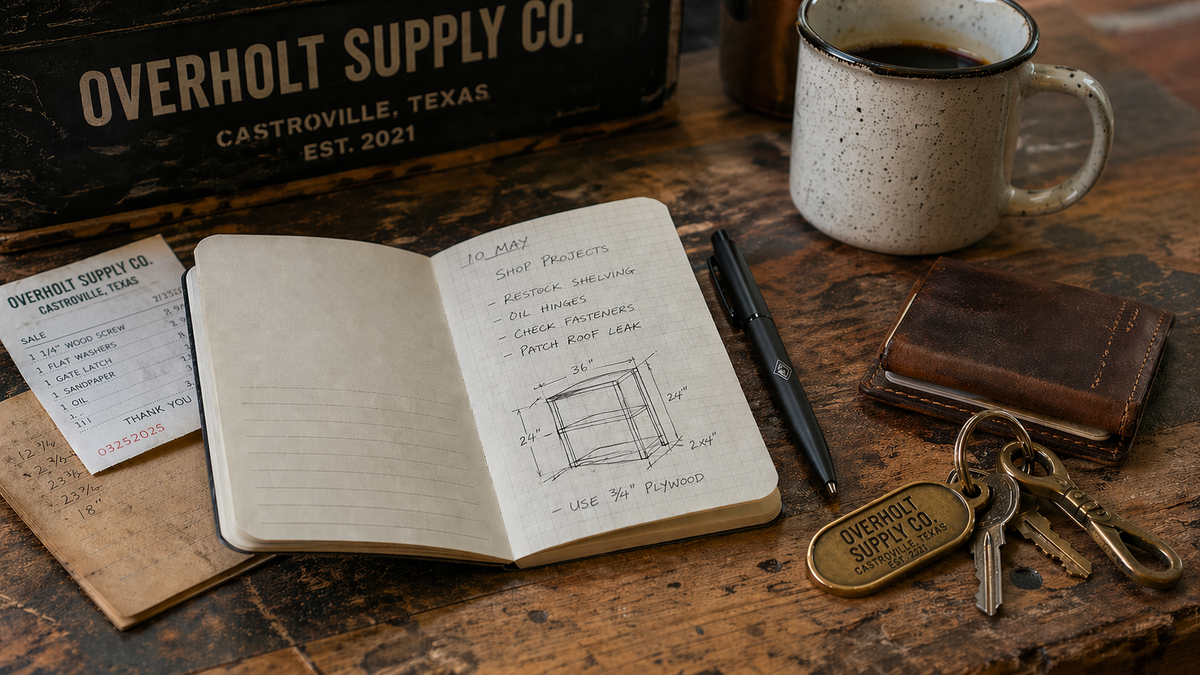
Most guys have tried carrying a notebook at some point.
They buy one, stick it in a pocket, throw it in the truck, or set it on the desk with the quiet confidence of a man who thinks a small stack of paper is about to straighten out his entire life. For a few days, it actually works. Measurements get written down. Lists get made. A good idea has somewhere to land before it disappears into the same mental junk drawer as old passwords, half-remembered errands, and the name of that guy from the thing.
Then it starts slipping.
The notebook gets left in the truck. Then it lives on the desk. Then it gets buried under receipts, mail, and one of those cords you can’t throw away because it might go to something important. Six months later, you find it with five pages used, one grocery list, two measurements with no context, and “call Mike” written like future you was supposed to know which Mike that meant.
That’s usually when a guy decides notebooks just don’t work for him.
But the notebook didn’t fail. Most of the time, the problem is that people take one of the simplest tools in the world and turn it into a whole production.
The Problem Starts When You Try to Build a System
A notebook is supposed to be paper you carry so you can write things down. That’s the whole machine. But a clean notebook has a strange effect on people. It makes them think they need a plan before they’re allowed to use it.
So they start building a system. Work notes in the front. Personal notes in the back. Ideas get a symbol. Tasks get a box. Important things get a star. Maybe there’s a table of contents, page numbers, color coding, and some clever little shorthand that makes perfect sense for about three days before turning into archaeology.
At that point, the notebook has stopped being useful and started being managed.
Now a simple note requires a decision. Does this go under work or home? Is this an idea or a task? Should I rewrite it cleaner later? Does this deserve its own page? Before long, writing something down feels like filing paperwork, and paperwork is exactly the sort of thing a pocket notebook was supposed to help you survive.
The fix is not a better system. The fix is no system, at least at first. Write the next thing on the next blank line and keep moving. If it matters later, you’ll find it. If it doesn’t, no great loss. You got it out of your head, and that alone is useful.
A notebook doesn’t need to be perfectly organized to work. It needs to be used.
Stop Waiting for Something Important Enough
New notebooks look a little too clean for their own good. The cover is still sharp, the pages are untouched, and suddenly a grocery list feels like vandalism. You don’t want to waste the first page on dog food, a cabinet measurement, or an idea that may be stupid by lunch.
So you wait for something worthy.
That mindset kills the notebook before it ever has a chance to earn its keep. A notebook is not a museum for your best thoughts. It is not there to prove that every idea you have belongs in a leather chair beside a fireplace. It is there to catch the ordinary stuff before it slips away.
The dumb stuff counts. The half-formed stuff counts. The thing you only need for ten minutes still counts.
Write down the grocery list. Write down the shirt size. Write down the cabinet measurement, the coffee order, the quote you liked, the part number, the name of the guy you met, the idea that might become something later, and the reminder your brain will absolutely throw into the ditch the minute life gets loud.
Some of it will matter later. Some of it won’t. That’s fine. The value of a notebook is not that every page becomes important. The value is that the important stuff has somewhere to land before you lose it.
It’s a Tool, Not a Whole Lifestyle
There’s nothing wrong with journaling. Some people need that, and good for them. But most guys don’t quit notebooks because they failed to reflect deeply enough on their inner weather. They quit because they turned a simple tool into another thing they were supposed to sit down and “do.”
That’s where the productivity crowd can lose the plot. They take a useful object and wrap it in routines, prompts, reviews, categories, morning rituals, evening rituals, and enough structure to make a pocket notebook feel like a second job with worse benefits.
For most real-world use, a notebook should feel closer to a screwdriver than a diary. You use it when you need it, and you don’t feel guilty when you don’t. It can hold thoughts, sure, but it can also hold measurements, lists, directions, rough sketches, order notes, prices, names, ideas, book recommendations, whiskey names, and whatever else needs somewhere to land.
That’s where it earns its place. Not when it becomes meaningful enough to impress somebody. When it becomes useful enough that you keep reaching for it.
The more normal you let it be, the more likely you are to actually use it.
Carry Size Matters More Than Desk Size
A notebook only works if it’s with you when you need it, which sounds obvious until you look at how many people buy notebooks that are too big to carry and then act surprised when they stop carrying them.
Big notebooks have their place. They’re good for desks, longer notes, planning, sketching things out, and creating the illusion that tomorrow will be far more organized than today was. But if a notebook is too large to keep on you, it eventually stays behind. You’ll mean to bring it. Then you won’t. Then the one time you actually need it, it’ll be sitting somewhere safe, clean, and completely useless.
That’s why pocket notebooks make sense.
Field Notes are a good example because they don’t try to be more important than the job. They’re small enough to carry, sturdy enough to get beat up, and simple enough that you don’t have to change your whole personality to use one. Back pocket, shirt pocket, truck console, shop apron, bag, counter — wherever your day actually happens, they can go there without making a production out of it.
That matters because the best notebook is not the nicest one you own. It’s the one you actually have on you when the thought, measurement, idea, or reminder shows up.
The Fix Is Mostly Lowering the Bar
If you want to use a notebook consistently, quit making it fancy. Don’t start by designing a system. Don’t wait for important thoughts. Don’t worry about making the pages look good. Don’t try to turn the whole thing into a personality trait.
Just write things down.
Use it for anything that needs somewhere to go. A list. A name. A measurement. A phone number. A bad idea. A good idea. A reminder. A sketch. A phrase. Something to buy. Something to fix. Something to remember long enough to get through the day.
The notebook does not care whether the thought is polished. It does not care whether your handwriting looks like it was done in a moving truck. It does not care if one page has a grocery list and the next has the beginning of a business idea. That’s not failure. That’s use.
A perfect notebook sitting untouched is just decoration. A beat-up notebook full of real notes is a tool.
That’s the difference.
Keep It Simple and Keep It Close
Most guys don’t need a better productivity method. They need a smaller notebook, a pen that works, and permission to write down ordinary things without making a ceremony out of it.
Carry it where you’ll actually carry it. Use it for what actually shows up. Let the pages get messy enough to prove they’re doing their job.
That’s how notebooks work in the real world.
Not as a system.
Not as a shrine.
Just paper, pocket, pen, and a place for the stuff you don’t want to lose.