
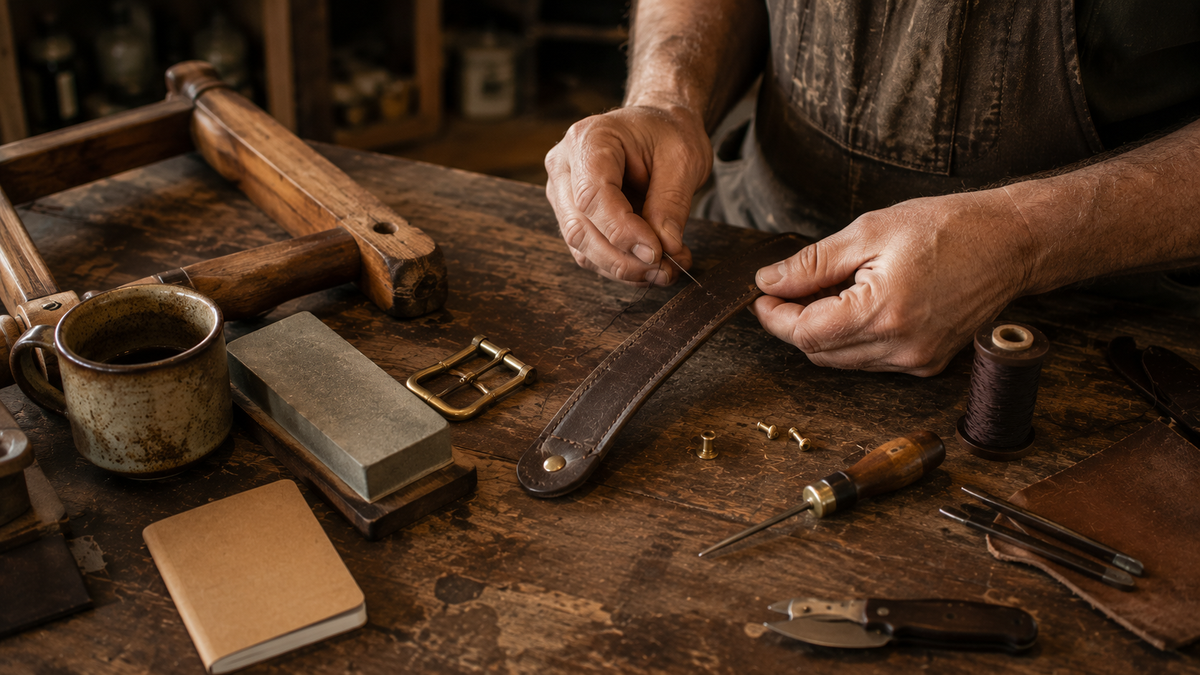
Most guys do not need to be master mechanics, cabinetmakers, leatherworkers, plumbers, or the kind of man who can rebuild a carburetor beside the road with a flathead screwdriver, a coffee can full of bolts, and one deeply held grudge against asking for help.
That is not the point.
The point is that every guy ought to know how to fix at least one useful thing well. Not well enough to limp it through the weekend, or well enough that the problem becomes someone else’s problem next Tuesday, but properly. Cleanly. In a way that leaves the thing better than you found it and gives you some confidence the repair will still be holding when the weather changes.
Maybe that means sharpening a knife. Maybe it means patching leather, replacing a faucet, tightening a loose chair, tuning a bicycle, sewing on a button, fixing a hinge, or bringing an old tool back into service. The skill itself matters, but what it teaches you along the way matters even more.
We Have Gotten Too Comfortable Throwing Things Away
Modern life has made replacement easier than repair, and most of us have gotten pretty used to it. Something breaks, so we order another one. The hinge gets loose, the zipper gives up, the handle cracks, the blade gets dull, the chair starts wobbling, and the first instinct is to decide the object has reached the end of its natural life.
Sometimes that is true. Plenty of modern goods are not really built to be repaired. They are clipped together, glued shut, made from mystery plastic, and designed with the quiet assumption that you will toss them before you start asking how the thing was put together in the first place.
But a lot of useful things get discarded simply because nobody wants to slow down long enough to figure out what actually failed. Repair asks you to look closer. You have to decide whether the whole thing is ruined or whether one small part has worked loose. You have to take something apart carefully enough that you can put it back together, and you have to resist the urge to force a piece that is clearly telling you, in the only language hardware knows, that you are doing it wrong.
That is useful work, and it is increasingly rare.
A man who can fix something is not necessarily smarter than everyone else. Most of the time, he has just learned to stay with a problem a little longer.
One Good Skill Changes the Way You See Problems
There is a shift that happens once you become competent at one repair.
At first, the whole job feels mysterious. You see a broken object, but you do not yet understand how the pieces relate to one another. You do not know which tool to use, how much pressure is too much, or whether the sound it just made was progress or the beginning of a much larger and more expensive problem.
Then you learn.
You buy the wrong part. You strip a screw. You sharpen a knife at an angle that would confuse both a butcher and a mathematician. You take something apart with complete confidence and then stare at the pieces like they arrived from another civilization with no instructions and a grudge against you personally.
Eventually, though, the job starts making sense. You stop seeing “a broken chair” and start seeing a loose joint. You stop seeing “a useless knife” and start seeing a dull edge. You stop seeing “the faucet is ruined” and start seeing a worn washer, a bad cartridge, or a fitting that needs attention.
That change is bigger than the repair itself, because once you understand that most problems are made of smaller problems, the whole mess becomes less intimidating. You stop reacting to the scale of the inconvenience and start looking for the part that actually failed.
That lesson travels. It follows you into work, home, business, and just about every other part of life where the first reaction is often, “Well, this is a mess.”
Maybe it is.
But which part is actually broken?
That is usually a better place to start.
Repair Teaches Patience Without Making a Speech About It
A lot of modern advice about patience comes packaged like a seminar.
Slow down. Be mindful. Trust the process. Breathe through the discomfort.
All true, probably.
But trying to reseat a stubborn hinge or line up a piece of hardware that is one-sixteenth of an inch off will teach you patience faster than any framed quote hanging in an office. Repair has consequences. If you rush, you bend something. If you force it, you strip something. If you skip a step, you get the pleasure of taking the whole thing apart again while muttering things that would not look good embroidered on a pillow.
The object does not care how busy you are. It does not care that you would like the job finished before lunch or that you already told someone it would only take twenty minutes. It will only go back together properly if you pay attention.
That kind of patience is not soft or theoretical. It lives in the hands. You learn when to push, when to stop, when to back the screw out and start again, and when the smartest move is to walk away for ten minutes before frustration turns a small repair into a larger purchase.
That last skill is worth learning early.
You Start Respecting How Things Are Made
Once you learn how to repair something, you start noticing construction in a way you did not before.
You look at stitching differently after you have repaired leather. You notice joinery after fixing a chair. You pay attention to hardware after replacing a hinge. You start understanding why one tool feels solid in the hand while another feels like it came free with a children’s meal and has roughly the same life expectancy.
You also become harder to fool.
Marketing can tell you something is rugged, heritage-inspired, workshop-tested, field-proven, and built for the long haul, but once you know even a little about how things go together, you start looking past the handsome words and the well-lit photograph.
How is it stitched? Can the hardware be replaced? Is the blade made from steel that will hold an edge? Can the handle be repaired? Are the parts accessible, or was the whole thing designed to become trash the first time one small component gives out?
Knowing how to fix one thing makes you a better judge of every version of that thing. That does not make you a snob. It just makes you less impressed by surface-level nonsense, and around here, we are generally in favor of that.
It Does Not Have to Be an Impressive Skill
This is where guys can make the whole thing weird.
The skill does not need to involve welding, rebuilding an engine, forging a knife, or constructing a cabin from trees you personally argued with. Useful beats impressive almost every time.
Knowing how to sew on a button properly is useful. So is sharpening a kitchen knife, patching a torn bag, fixing a loose cabinet door, replacing a broken strap, changing a bicycle tube, cleaning and conditioning leather, or repairing a lamp that stopped working because one wire came loose.
These are not heroic acts, and that is exactly why they matter. They are small pieces of competence that make ordinary life run better. You save money, waste less, become less helpless when something minor goes wrong, and stop treating every loose screw like a reason to call a committee.
There is also a quiet satisfaction in returning something to service. The chair no longer wobbles. The blade cuts again. The old bag has another few years in it. The faucet stops dripping. The button stays attached.
Nobody throws a parade. Nobody gathers around for a dramatic reveal. The thing simply works again because you understood what was wrong and knew how to put it right.
That is enough.
Start With Something You Already Use
The easiest way to learn a repair skill is to choose something already in your life.
Do not pick a skill because it looks good online or because some man in a waxed apron made it look noble in a twelve-minute video with excellent lighting. Start because you own the thing, use the thing, and would benefit from knowing how to keep it going.
Carry a knife? Learn to sharpen it.
Wear boots or carry a leather bag? Learn basic leather care and how to handle a minor repair before a little crack becomes a big one.
Ride a bicycle? Learn to fix a flat and adjust the brakes.
Own furniture? Learn how to tighten and reglue a loose joint.
Wear shirts? Learn how to replace a button without creating a knot the size of a field mouse.
Have a house? Learn one basic plumbing repair before the sound of dripping water begins controlling your emotional state.
The goal is not to become the town expert. It is to move one useful task from “I have no idea” to “I know how to handle that.” That is a modest gain, but modest gains have a way of becoming dependable parts of a man’s life.
Learn It Well Enough to Trust Yourself
There is a big difference between watching one video and knowing how to do something.
A video can show you the steps. Practice teaches you the feel.
You learn how sharp is sharp, how tight is tight, how much pressure the material can take, which shortcut is harmless, and which shortcut creates a second repair. You learn the small things that never make it into the instructions because the person teaching has done them so many times they no longer realize they know them.
That only comes from repetition.
So practice on something low-risk if you can. Make mistakes where the stakes are small. Ask someone who knows more than you. Use the right tool instead of inventing a new purpose for locking pliers and then blaming the hardware when things go badly.
Eventually, you get to the point where the repair no longer feels like a special event. You just do it. The tools come out, the problem gets handled, and the thing goes back into service.
That is where competence becomes useful.
The Real Value Is Not Being Helpless
Knowing how to fix one thing will not turn you into a master craftsman, and it will not make you self-sufficient, because nobody really is.
We all rely on people who know things we do not. That is how towns, trades, shops, families, and civilization in general keep the wheels attached. There is no shame in calling the plumber, taking the truck to a mechanic, or handing a job to somebody who has spent years learning how not to make it worse.
But knowing one repair well gives you a foothold. It reminds you that not every problem requires replacement, not every failure is final, and not every useful object has to be discarded because one part gave out.
It also gives you a little more faith in your own ability to figure things out, and that may be the best part. Not the repaired chair. Not the sharpened knife. Not the faucet that finally stopped making that noise at two in the morning.
The best part is the moment when something breaks and your first thought is no longer, “Well, I guess that is done.”
Instead, you take a closer look.
Start With One Thing
Pick one useful repair and learn it well.
Not ten skills. Not a whole new identity. Not a garage full of tools purchased in advance of abilities you may or may not develop. Just one thing that already has a place in your life.
Learn the parts. Learn the tools. Practice until you can do the job without turning the room blue or searching for a missing spring on your hands and knees.
Then keep that skill. Use it when it is needed. Pass it along when somebody asks. Let it change the way you look at broken things.
You do not need to know how to fix everything.
But you ought to know that some things are worth fixing, and that you are capable of learning how.