
Dave here —
Whiskey is one of those things that ought to be simple.
Grain. Water. Yeast. Oak. Time.
That’s the basic machinery. Pretty honest stuff. The kind of thing a reasonable man could understand without needing a laminated chart, a velvet blazer, and a vocabulary that makes everyone at the table want to fake an emergency phone call.
And yet, somehow, whiskey has become one of the great performance arts of modern manhood.
There’s always one guy.
He picks up the glass like he’s holding a dead sea scroll. He swirls it six times. He squints. He sniffs. He says something about “stone fruit,” “wet tobacco,” “old saddle leather,” and “the emotional weight of late October.” Then everyone else nods because nobody wants to be the first man brave enough to say:
“Buddy, it tastes like whiskey.”
Now, to be fair, whiskey can be complex. There are real notes in there. Real differences. Real craft. Real history. Real reasons one bottle costs $28 and another costs as much as a decent used lawn mower.
But you do not need to pretend you know everything to enjoy it.
Matter of fact, pretending you know everything is one of the quickest ways to ruin the whole thing.
So let’s talk about whiskey like normal people.
Useful information. No velvet rope. No secret handshake. No man in a waistcoat telling you your ice cube dishonored his ancestors.
Just a beginner’s guide to drinking whiskey, enjoying whiskey, and looking reasonably competent while doing it.
Start Here: Whiskey Is Not a Personality Test
The first thing to know is this:
There is no single correct way to drink whiskey.
There are better ways to taste it. There are traditional ways to serve it. There are glasses that help, ice cubes that make sense, and bottles that deserve more attention than others.
But at the end of the day, whiskey is meant to be enjoyed.
Not endured.
Not performed.
Not turned into a TED Talk with a cork stopper.
If you like it neat, drink it neat.
If you like it with ice, add ice.
If you like a splash of water, splash away.
If you like it in an Old Fashioned, you’re among friends here.
If you put it with Coke because it’s 97 degrees outside, your grill is flaring up, and your brother-in-law is explaining cryptocurrency again, well, desperate times require practical measures.
The important thing is honesty.
Drink what you like. Learn as you go. Don’t act like the ghost of a Kentucky distiller is standing behind you with a clipboard.
Glassware: The Tools of the Operation
Let’s start with the vessel.
The glass matters.
Not in a mystical way. Not in a “this glass was forged under a blood moon by fourth-generation monks” way. But it does matter.
A glass changes how whiskey smells, how it opens up, how it sits in your hand, and — let’s be honest — how much the whole thing feels like a proper little moment instead of just drinking brown liquor out of whatever was clean.
The Rocks Glass
This is the workhorse.
The rocks glass is the pickup truck of whiskey glassware. Short. Sturdy. Useful. Not trying to impress anybody at the country club, but somehow still better looking than half the stuff that is.
Heavy bottom. Wide mouth. Good feel in the hand.
Is it the most precise tasting glass in the known scientific universe? No.
Does it look right next to a notebook, a pocketknife, a leather coaster, and a lamp that has seen things? Yes, it does.
This is the glass for a simple pour, whiskey over ice, an Old Fashioned, or the kind of evening where you are not “evaluating flavor profiles” so much as sitting down and letting the day loosen its grip a little.
It’s also why we like our Overholt Supply Co. Whiskey Glass Candles so much.
They start as candles. They finish as rocks glasses.
That’s the whole trick.
We pour them right here in our shop in Castroville, Texas, using 100% soy wax in a real whiskey glass. You burn the candle. You enjoy the scent. When it’s done, you clean it out and put the glass back to work.
Light-duty morale improvement first.
Whiskey service later.
That’s what we call good honest utility.
Not throwaway junk. Not decorative nonsense that exists only to collect dust and judgment. A good glass with a job today and another job tomorrow.
We’re big fans of that kind of thinking.
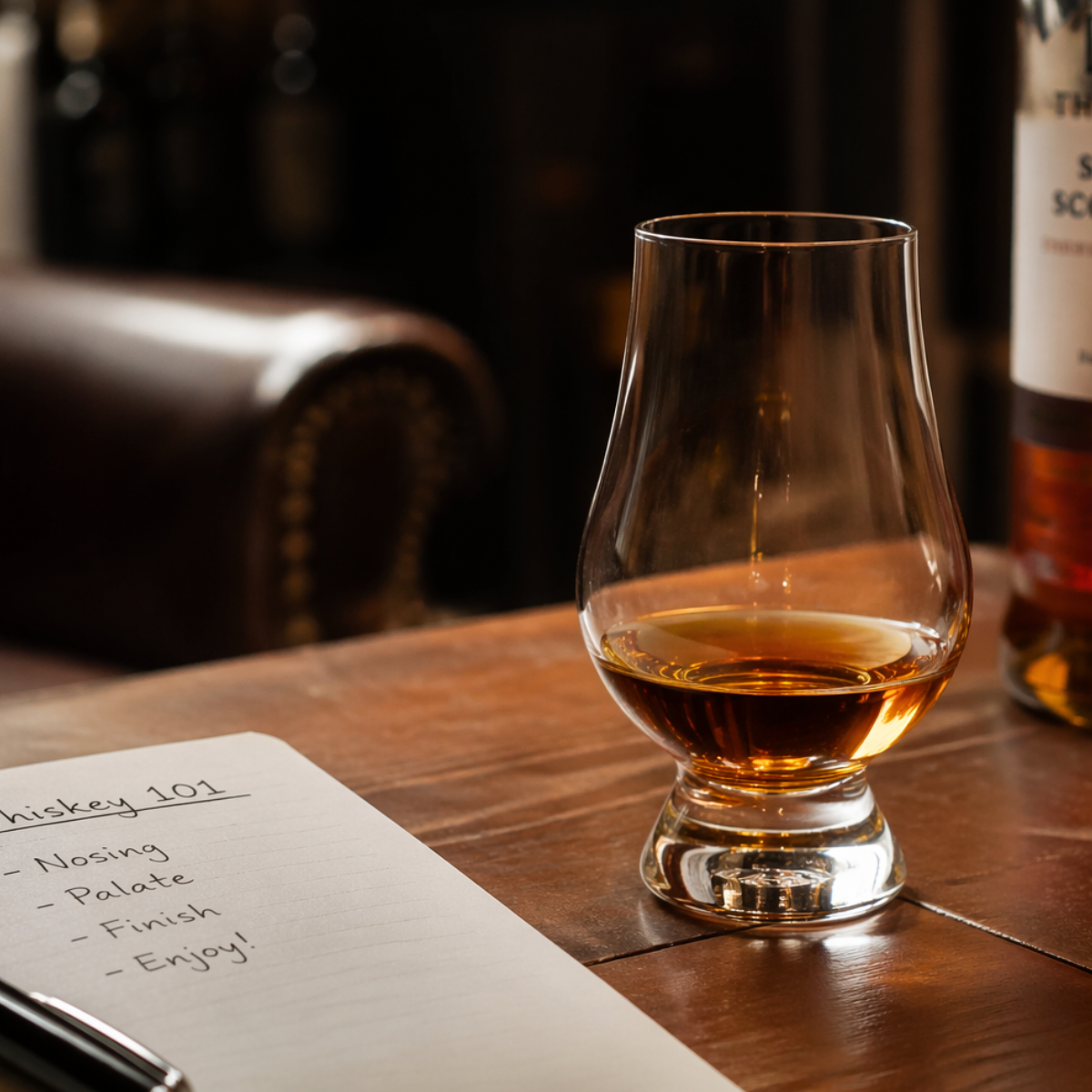
The Glencairn
The Glencairn is the little tulip-shaped whiskey glass you see in tasting rooms, distillery tours, and videos where a guy with suspiciously perfect shelves says, “Let’s get into the nose on this one.”
And to its credit, the Glencairn works.
The shape concentrates the aroma and helps you pick up more of what’s going on in the whiskey. If you’re comparing bottles, trying to learn, or pretending your kitchen counter is a tasting panel, it’s a great tool.
You do not need one to begin.
But having one isn’t a bad idea.
Think of it like owning a decent screwdriver. You can get by without it for a while, but once you have the right tool, you realize why people kept bringing it up.
The “Whatever’s Clean” Glass
We’ve all been there.
Coffee mug. Mason jar. Slightly suspicious tumbler from the back of the cabinet. A souvenir glass from a wedding you barely remember attending.
Is it ideal?
No.
Will civilization collapse?
Also no.
This is where whiskey people need to calm down a notch. A proper glass helps. It does not make you a better person.
Use what you have. Upgrade when you care enough to upgrade.
That’s a fine rule for most things.
Ice vs. No Ice: The Cold War Nobody Asked For
 Nothing makes whiskey people argue faster than ice.
Some folks believe whiskey should only be drunk neat, at room temperature, in a silent room, while thinking serious thoughts about oak barrels and inheritance.
Other folks want a big cube in the glass, preferably one so large it looks like it was harvested from a glacier by a man named Hank.
Here’s the truth:
Both are fine.
They just do different things.
Neat
Drinking whiskey neat means whiskey in a glass. Nothing else.
No ice. No water. No mixer. No fruit. No tiny umbrella, unless your life has taken a very interesting turn.
Neat is the best way to experience the whiskey exactly as it came from the bottle. You’ll get more aroma, more heat, more intensity, and more of the character the distiller intended.
That can be wonderful.
It can also be a lot.
Especially at first.
If you’re new to whiskey and your first neat pour tastes like a campfire got into a fistfight with a medicine cabinet, don’t panic. That doesn’t mean you’re weak. That means whiskey has alcohol in it and your tongue is not yet trained to politely ignore the obvious.
Start slow.
Small pour. Small sip. Let it sit. Don’t inhale it like cough syrup before a middle school band concert.
Give your palate a minute to clock in.
With Ice
Ice chills whiskey. That makes it smoother and less aggressive. As the ice melts, it adds water, which can soften the alcohol and change the flavor.
This is not illegal.
This is not childish.
This is not a moral failure.
A large cube is nice because it melts slowly. It chills the drink without turning it into a watered-down puddle in five minutes. Small cubes work too, but they melt faster.
Use ice if you want ice.
Anyone who yells at you about that should be handed a room-temperature glass of humility.
With Water
This one sounds wrong to beginners until they try it.
A few drops of water can open up a whiskey, especially a higher-proof bottle. It can knock down the alcohol burn and let other flavors step forward.
Not a gallon.
Not a garden hose.
A few drops.
Maybe a teaspoon.
You are not baptizing the whiskey. You are helping it introduce itself.
Cheap vs. Expensive: The Bottle Is Not a Résumé
Here’s where people get real weird.
There is a belief that expensive whiskey is automatically better whiskey.
That is not true.
There is also a backlash belief that cheap whiskey is somehow more honest, and anything expensive is just hype in a fancy bottle.
That is also not true.
The truth is sitting somewhere in the middle, leaning against the bar, minding its own business.
Some expensive whiskey is excellent. Some expensive whiskey is rare. Some took years to make, years to age, and years to track down.
Some expensive whiskey tastes like marketing department smoke and mirrors poured over oak chips.
Some affordable whiskey is fantastic. Some is dependable. Some is perfect for cocktails, tailgates, porch nights, and not feeling like you need a security detail every time someone reaches for the bottle.
Some cheap whiskey tastes like a dare.
Price tells you something.
It does not tell you everything.
What You’re Often Paying For
With higher-priced bottles, you may be paying for age, scarcity, proof, special barrels, limited releases, brand reputation, packaging, allocation, or the fact that people on the internet lost their collective minds over it.
Sometimes that higher price is justified.
Sometimes it’s just a nice label wearing a tiny top hat.
The smart move is not to chase expensive bottles just because they’re expensive.
The smart move is to figure out what you actually like.
What Actually Matters
Here’s the part to tape to the inside of the cabinet.
The whiskey that matters is the whiskey you enjoy, can afford, and are not pretending about.
That’s it.
Everything else is seasoning.
But since we are trying to be somewhat useful around here, here are the things worth paying attention to.
Proof
Proof tells you how strong the whiskey is.
In the United States, proof is double the alcohol by volume. So 90 proof means 45% alcohol.
Higher proof usually means more intensity. More heat. Sometimes more flavor. Sometimes more chaos.
Barrel-proof bottles can be excellent, but they can also hit like a mule with unfinished business.
If you’re just starting out, don’t feel like you need to leap straight into the high-proof stuff. Start somewhere reasonable. Learn what you like. Build from there.
Nobody gets a medal for coughing with confidence.
Flavor
This is where the flim-flam gets thick, so keep it simple.
Do you like sweet?
Spicy?
Smoky?
Smooth?
Rich?
Dry?
Oaky?
Easy-drinking?
That’s enough vocabulary to get you started.
Bourbon often leans sweeter: vanilla, caramel, brown sugar, oak, baking spice.
Rye often brings more spice and bite.
Irish whiskey is usually approachable and smooth.
Scotch is a whole continent of possibilities, ranging from honeyed and gentle to “somebody set a boat on fire in a peat bog.”
You do not need to know the map before you take the trip.
Just start noticing.
Purpose
Not every bottle needs to be a museum piece.
Some whiskey is for sipping slowly.
Some is for cocktails.
Some is for sharing.
Some is for keeping around because it does the job and doesn’t require you to refinance a tractor.
A good home bar has levels.
The everyday pour.
The cocktail bottle.
The “company is coming over” bottle.
The “something good happened” bottle.
The “something bad happened, but we’re not talking about it yet” bottle.
All useful. All valid.
How to Taste Whiskey Without Becoming Insufferable
There is a way to taste whiskey without turning into the kind of person people avoid at parties.
Here’s the entire system.
Pour a little whiskey into a glass.
Look at it for half a second if you want. It’s brown. Sometimes golden brown. Sometimes darker. Congratulations, we’re underway.
Smell it gently.
Do not bury your nose in the glass like you dropped a contact lens in there. Alcohol vapor is real, and it will punch you in the sinuses if you go charging in.
Take a small sip.
Let it sit on your tongue for a second.
Swallow.
Notice what happened.
Take another sip.
That’s when things usually get clearer. The first sip wakes up your palate. The second sip tells you more.
Maybe you taste vanilla. Maybe caramel. Maybe pepper. Maybe oak. Maybe smoke. Maybe cherry. Maybe you taste “yep, whiskey.”
That is fine.
You are not failing.
You are calibrating.
There’s a difference.
A Small Word on Tasting Notes
Tasting notes are useful until they become theater.
If someone says they taste vanilla, caramel, oak, or pepper, that probably makes sense.
If someone says they taste “sun-warmed leather-bound hymnals in an abandoned train depot,” they may need a sandwich and some outside time.
Use tasting notes as hints, not commandments.
You are allowed to taste something different.
You are also allowed to taste less.
Your palate develops the same way anything develops: by paying attention over time.
Not by pretending.
A Few Rules for the Decent Whiskey Drinker
Drink slowly.
Drink water.
Eat something.
Don’t make the strongest pour the first pour.
Don’t shame a man for using ice.
Don’t waste great whiskey on people trying to prove a point.
Don’t buy bottles only because strangers online are yelling about them.
Don’t start any sentence with, “Real whiskey drinkers…”
Real whiskey drinkers are too busy enjoying their whiskey to be policing yours.
Where the Candle Comes Back In
Now, because we are a general store and not a monastery, we like objects that earn their keep.
keep.
That’s the thinking behind our Whiskey Glass Candles.
They are poured in our shop in Castroville, Texas. They’re made with 100% soy wax. They smell good. They look good. They sit on a desk, counter, shelf, bar cart, or table like they belong there.
And when the candle has done its job, the glass is not done.
That matters to us.
We like second lives around here.
Old buildings. Old stories. Old tools. Good denim. Leather that breaks in instead of breaks down. Candles that become whiskey glasses.
When your candle burns down, put the glass in the freezer for a bit, pop out the remaining wax, wash it well, and there you go.
You now have a rocks glass with a little history baked into it.
Not fake history.
Not “heritage-inspired lifestyle accessory” history.
Actual use.
It was a candle.
Now it’s a whiskey glass.
That’s the kind of honest little transformation we can get behind.
Final Pour
Whiskey does not need to be complicated.
It can be, if you want it to be. There’s plenty to learn. Mash bills. Barrel char. Regions. Aging. Proof. Blending. Distilling history. All that good nerdy machinery is there when you’re ready.
But you do not need to learn everything before you start.
Start with a decent bottle.
Pour a little.
Try it neat.
Try it with ice.
Try it with a splash of water.
Use a rocks glass because it feels right. Use a Glencairn because it helps. Use whatever’s clean because life comes at you fast.
Pay attention to what you like.
Ignore the guy trying to turn your drink into a dissertation.
And remember: the point is not to look like you know everything.
The point is to enjoy the pour, tell the truth, and maybe light a good candle while you’re at it.
Because a good room, a good glass, and a good whiskey all have something in common.
They don’t need to announce themselves.
They just need to be made well enough that you notice.
